
I am leaving Denmark tomorrow. I am very grateful for everything that has happened to me in the three years I spent in this wonderful place. Now it is time to move on. Tusind tak allesammen!
Author: Alexander Kyd
They’re here
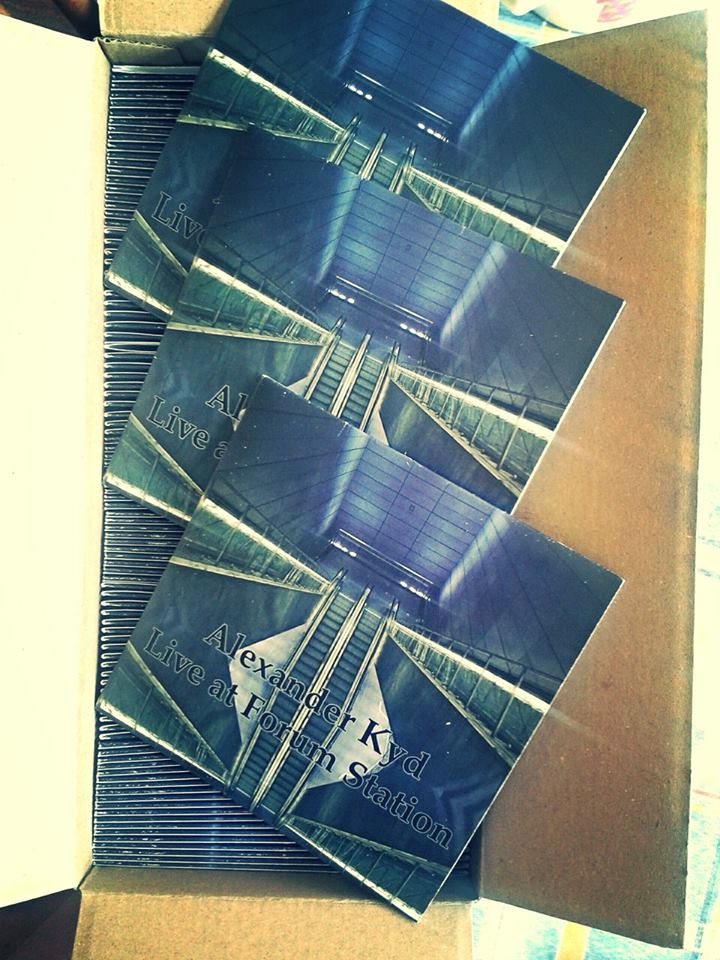
Live at Forum Station CD
Forum
Unveil is just an intro to Vranya Stena. The rest of the tracks are basically reworked versions of old pieces. Sever is the only one that was not on my 2011 studio debut, although it’s probably older than many of the ones that made it then.
On Silence
“The twentieth century is, among other things, the Age of Noise. Physical noise, mental noise and noise of desire – we hold history’s record for all of them. And no wonder; for all the resources of our almost miraculous technology have been thrown into the current assault against silence. That most popular and influential of all recent inventions, the radio, is nothing but a conduit through which pre-fabricated din can flow into our homes. And this din goes far deeper, of course, than the eardrums. It penetrates the mind, filling it with a babel of distractions, blasts of corybantic or sentimental music, continually repeated doses of drama that bring no catharsis, but usually create a craving for daily or even hourly emotional enemas. And where, as in most countries, the broadcasting stations support themselves by selling time to advertisers, the noise is carried from the ear, through the realms of phantasy, knowledge and feeling to the ego’s core of wish and desire. Spoken or printed, broadcast over the ether or on wood-pulp, all advertising copy has but one purpose – to prevent the will from ever achieving silence. Desirelessness is the condition of deliverance and illumination. The condition of an expanding and technologically progressive system of mass production is universal craving. Advertising is the organized effort to extend and intensify the workings of that force, which (as all the saints and teachers of all the higher religions have always taught) is the principal cause of suffering and wrong-doing and the greatest obstacle between the human soul and its Divine Ground.”
Aldous Huxley, The Perennial Philosophy (1945)
Coming up for air
“You know the smell churches have, a peculiar, dank, dusty, decaying, sweetish sort of smell.There’s a touch of candle-grease in it, and perhaps a whiff of incense and a suspicion of mice, and on Sunday mornings it’s a bit overlaid by yellow soap and serge dresses, but predominantly it’s that sweet, dusty, musty smell that’s like the smell of death and life mixed up together. It’s powdered corpses, really.”
George Orwell, Coming up for air
Oblivion (Metro)
I went to Forum Station in Copenhagen and played Oblivion from my first album. Then I went back home and played with the recording for a while. The result is my idea of a B-movie sci-fi horror score or something. Hope you like it.
Welcome to the machine
“Henry Ford had once been an ordinary automobile manufacturer. Now he experienced an ecstasy greater and more intense than that vouchsafed to any American before him, not excepting Thomas Jefferson. He had caused a machine to replicate itself endlessly. His executives and managers and assistants crowded around him to shake his hand. Tears were in their eyes. He allotted sixty seconds on his pocket watch for a display of sentiment. Then he sent everyone back to work. He knew there were refinements to be made and he was right. By controlling the speed of the moving belts he could control the workers’ rate of production. He did not want a worker to stoop over or to take more than one step from his work site. The worker must have every second necessary for his job but not a single unnecessary second. From these principles Ford established the final proposition of the theory of industrial manufacture—not only that the parts of the finished product be interchangeable, but that the men who build the products be themselves interchangeable parts.”
E.L. Doctorow, Ragtime
A hippie sermon
“When the soul leaves the body it approaches the void and there it is assailed by temptations. In its first temptation it encounters two people fucking – naturally what remains of its prurient interest is aroused. It draws closer and closer until it’s drawn in. It has been visualizing its own conception. It goes back the way it came and that’s the end of liberation.”
Robert Stone, Dog Soldiers
Still water
THE PEACE OF WILD THINGS
When despair for the world grows in me
and I wake in the night at the least sound
in fear of what my life and my children’s lives may be,
I go and lie down where the wood drake
rests in his beauty on the water, and the great heron feeds.
I come into the peace of wild things
who do not tax their lives with forethought
of grief. I come into the presence of still water.
And I feel above me the day-blind stars
waiting with their light. For a time
I rest in the grace of the world, and am free.
— Wendell Berry
But the quiet grows and grows
‘There are quiet places in the mind,’ he said meditatively, ‘But we build bandstands and factories on them. Deliberately—to put a stop to the quietness. We don’t like the quietness. All the thoughts, all the preoccupations in my head—round and round, continually.’ He made a circular motion with his hand. ‘And the jazz bands, the music-hall songs, the boys shouting the news. What’s it for? What’s it all for? To put an end to the quiet, to break it up and disperse it, to pretend at any cost it isn’t there. Ah, but it is; it is there, in spite of everything, at the back of everything. Lying awake at night, sometimes – not restlessly, but serenely, waiting for sleep – the quiet re-establishes itself, piece by piece; all the broken bits, all the fragments of it we’ve been so busily dispersing all day long. It re-establishes itself, an inward quiet, like this outward quiet of grass and trees. It fills one, it grows – a crystal quiet, a growing, expanding crystal. It grows, it becomes more perfect; it is beautiful and terrifying, yes, terrifying as well as beautiful. For one’s alone in the crystal and there’s no support from outside, there’s nothing external and important, nothing external and trivial to pull oneself up by or to stand on, superiorly, contemptuously, so that one can look down. There’s nothing to laugh at or feel enthusiastic about. But the quiet grows and grows. Beautifully and unbearably. And at last you are conscious of something approaching; it is almost a faint sound of footsteps. Something inexpressibly lovely and wonderful advances through the crystal, nearer, nearer. And, oh, inexpressibly terrifying. For if it were to touch you, if it were to seize and engulf you, you’d die; all the regular, habitual, daily part of you would die. There would be an end of bandstands and whizzing factories, and one would have to begin living arduously in the quiet, arduously in some strange, unheard-of-manner. Nearer, nearer come the steps; but one can’t face the advancing thing. One daren’t. It’s too terrifying, it’s too painful to die. Quickly, before it is too late, start the factory wheels, bang the drum, blow up the saxophone. Think of the women you’d like to sleep with, the schemes for making money, the gossip about your friends, the last outrage of the politicians. Anything for a diversion. Break the silence, smash the crystal to pieces. There, it lies in bits; it is easily broken, hard to build and easy to break. And the steps? Ah, those have taken themselves off, double quick. Double quick, they were gone at the first flaying of the crystal. And by this time the lovely and terrifying thing is three infinities away, at least. And you lie tranquilly on your bed, thinking of what you’d do if you had ten thousand pounds, and of all the fornications you’ll never commit.’
Aldous Huxley, Antic Hay
 Alexander Kyd